
If you searched for LTL furniture transport rather than “movers,” you already know something most people shipping furniture don’t: the method you choose matters more than the carrier’s marketing.
The problem is that four completely different industries will happily take your furniture, and they price, handle, and protect it in ways that have almost nothing in common. A designer shipping a single commissioned dining table, a manufacturer moving forty cartons to a retailer, and a hotel receiving a floor’s worth of FF&E are three entirely different logistics problems – and picking the wrong one is where damage claims and budget overruns come from.
This guide explains what LTL furniture transport actually is, how it compares to full truckload, household movers, and parcel, and how to tell which one your shipment needs.
LTL, defined
LTL in most cases stands for “less than truckload.” It means your freight shares trailer space with other shippers’ freight, and you pay for the portion you occupy rather than for the whole truck.
A 53-foot trailer holds roughly 26 standard pallets. If you have four pallets’ worth of furniture, chartering the entire trailer means paying for 22 empty pallet positions.
LTL solves that: the carrier consolidates your shipment with others heading the same direction, and each shipper pays a share.
The trade-off is straightforward. LTL costs less than a dedicated truck but involves more handling – your freight is loaded alongside other cargo, and in most LTL networks it passes through terminals where it’s unloaded, sorted, and reloaded en route.
That last point is the entire reason furniture LTL is a specialty rather than a commodity.
Why furniture LTL is not the same as regular LTL
Standard LTL networks are engineered for boxed, palletized, forklift-friendly freight moving hub-to-hub. Furniture breaks that model in three specific ways.
It’s low density, and freight class punishes that
Traditional LTL prices freight using the NMFC classification system, which is driven largely by density – pounds per cubic foot. Furniture is bulky and light. A sectional sofa might weigh 180 pounds while occupying 90 cubic feet, giving it a density of about 2 lbs/ft³, which lands in the highest and most expensive freight classes.
Put plainly: standard LTL pricing was designed for dense industrial goods, and it treats furniture as an expensive anomaly. Specialized furniture carriers price on cubic volume instead, which reflects what furniture actually consumes – space.
It’s often unboxed, and standard LTL assumes packaging
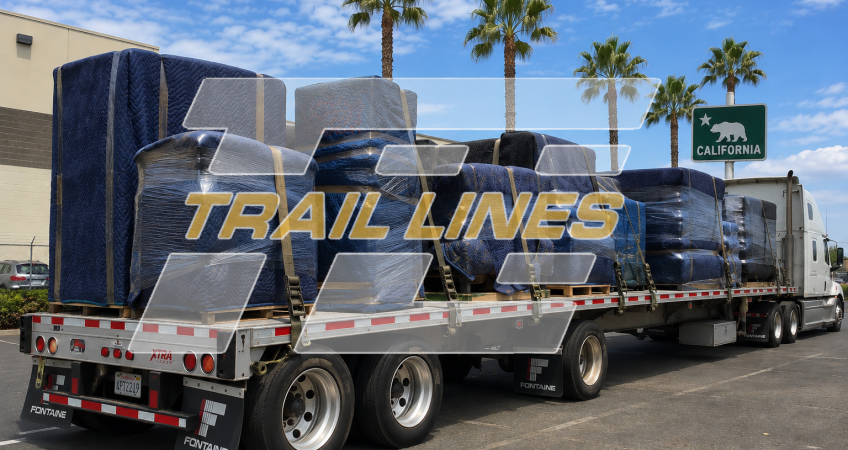
Finished goods leaving a plant, floor models rotating out of a showroom, and specified designer pieces frequently have no carton. Standard LTL terminals handle freight with forklifts and expect a pallet and a box. Furniture carriers use blanket wrap – thick moving blankets applied directly to the piece and secured, then loaded and decked by hand.
Handling count, not distance, drives damage
This is the most important operational fact in furniture freight. A piece that travels 400 miles on a single well-strapped trailer will usually arrive perfect. A piece that gets cross-docked three times will not. Every terminal transfer is a forklift, a dock plate, an exposed corner, and a handler who has never seen your product.
Standard LTL networks are built around those transfers – it’s how consolidation economics work. Specialized furniture LTL carriers deliberately minimize them, often running direct or near-direct on regional lanes. Fewer touches is the product.
The four ways to move furniture, compared
| Trail-lines LTL | Specialized LTL | Full truckload (FTL) | Household movers | Parcel |
|---|---|---|---|---|
| Best for | Multiple pieces, partial loads, recurring commercial shipments | Full trailer loads, high-value single-consignee runs | Whole-home and office relocations | Small, boxed, sub-150 lb items |
| Priced on | Cubic volume | Whole trailer / per mile | Hourly or weight + distance | Dimensional weight |
| Packaging | Blanket wrap or crating | Blanket wrap or palletized | Blanket wrap, packed on site | Carton required |
| Handling events | Low – often 2 – 4 | Lowest – typically 2 | Low, but multiple manual moves | Highest – 8+ automated sorts |
| Typical cost | Moderate | Highest total, best per-unit at volume | High for small loads | Lowest, if it fits |
| Damage risk for furniture | Low | Lowest | Low | High |
| Schedule flexibility | Consolidated windows | Fully dedicated | Fixed appointment | Network-driven |
When LTL is the right call
- You have more than one piece but less than a trailer. This is the core case. Somewhere between a single armchair and 26 pallets, our LTL services are almost always the most economical option that still protects your goods.
- You ship the same lane repeatedly. Manufacturers supplying retailers, distributors serving showrooms, and importers moving product from the ports inland get the best of LTL – the carrier already runs your route, so consolidation is efficient and rates are stable.
- Your timeline has some flexibility. Consolidation requires the carrier to build a load. If your delivery window is a few days rather than a fixed hour, you capture the savings.
- The pieces are valuable enough to need blanket wrap but not numerous enough to fill a truck. Designer furniture, antiques, showroom inventory, executive casegoods.
- You need accessorial services. Specialized furniture LTL carriers typically offer white glove delivery, inside placement, assembly, warehousing, and staging. Standard freight carriers do not, and parcel certainly does not.
When full truckload wins instead
Your shipment fills a trailer, or nearly does. Past roughly 12–15 pallet positions, dedicated economics usually beat LTL per unit.
Timing is fixed and non-negotiable. A hotel opening, a trade show install, a store grand opening. FTL is dedicated – your freight is the only freight, and it moves on your schedule.
Handling risk must be zero. Museum pieces, irreplaceable antiques, extremely high-value commissioned work. FTL means the trailer is loaded once and unloaded once.
One origin, one destination. FTL’s advantage evaporates with multiple stops.
When a household mover is the better fit
Household goods movers are a genuinely different service, and for the right job they’re the right answer.
Use a mover when: you’re relocating an entire home or office, you need packing done on site, you need furniture disassembled and reassembled as part of a whole-premises move, or you’re moving lived-in belongings rather than product.
Use LTL when: you’re shipping product rather than possessions – new furniture, showroom inventory, a designer’s specified pieces, FF&E for a project. Movers price by the hour or by weight-and-distance for a whole household, and applying that model to eight boxes of chairs from a manufacturer produces a bad number.
A useful test: if the furniture is new, or it’s inventory, or it’s going to a business – you want a freight carrier. If it’s lived-in and it’s going to a home as part of a relocation – you want a mover.
When parcel is fine (and when it’s a mistake)
Parcel carriers work for small, boxed, sturdy items under about 150 pounds – a disassembled side table, a set of chairs in factory cartons, hardware and components.
Parcel is a mistake for anything unboxed, fragile, oversized, or finished. Parcel networks are automated sortation systems: conveyor belts, chutes, drops, and eight or more handling events. Nothing in that system was designed with a lacquered surface in mind. Oversize surcharges also escalate steeply, and a large item often costs more via parcel than via LTL while arriving in worse condition.
A decision framework
Work through these in order.
1. Is every item boxed, sturdy, and under 150 lbs? Yes → parcel is likely cheapest. No → continue.
2. Are you relocating lived-in contents from a home or occupied office? Yes → household mover. No → continue.
3. Will your freight fill more than roughly half a trailer, or is your delivery time fixed to a specific hour? Yes → full truckload. No → continue.
4. Everything else → specialized furniture LTL.
Then apply one override: if the goods are unboxed, finished, or high-value, insist on blanket wrap and air-ride equipment regardless of which method you chose. That single requirement eliminates most furniture damage.
What “local LTL furniture transport” actually gets you
Searching for a local carrier isn’t just about proximity to your dock. Regional specialists offer real structural advantages:
- Shorter lanes mean fewer transfers. A carrier running Los Angeles to San Diego regularly can often move your freight direct. A national network may route the same shipment through a hub hundreds of miles out of the way.
- Local access knowledge. California punishes carriers who improvise. Design center appointment systems, downtown dock windows, hillside neighborhoods that can’t accept a 53-foot trailer, port drayage timing, CARB compliance – these are learned, not looked up.
- Accountability. Regional carriers are usually asset-based, meaning they own the trucks and employ the drivers. Ask any carrier directly: are you hauling this yourself, or brokering it? Brokers post freight to a load board and the lowest bidder hauls it. You won’t know who touched your furniture. Neither will they.
- Warehousing near your market. On project work – hospitality FF&E, design installs, phased office moves – dates slip constantly. A carrier with local storage holds your goods. A carrier without one delivers to a site that isn’t ready.
Conclusion
LTL furniture transport is the middle path – cheaper than chartering a trailer, safer than parcel, and priced far more sensibly than a household mover for commercial product. It’s the right choice for most furniture shipments that are bigger than a box and smaller than a truckload.
But “LTL” alone isn’t the specification. Specialized furniture LTL – cubic-volume pricing, blanket wrap, air-ride trailers, minimal handling – is a different service from standard freight LTL, and the difference shows up on your delivery receipt.
Trail Lines Inc. has run specialized LTL furniture transport across California since the 1990s. We’re asset-based, we run air-ride equipment, and our terminal in Santa Fe Springs sits minutes from the 5, 605, and 91. Request a rate quote or call (323) 728-7270 for a real number on your lane.